

Social Sciences vs STEM: How Data Analysis Approaches Differ
Data analysis is a crucial step in the research process, and the methods and tools employed vary significantly across different disciplines. In particular, researchers in fields in STEM (Science, Technology, Engineering, and Mathematics) and the social sciences utilize different data analysis techniques customized based on the data types, research questions, and objectives. If you’re looking for experts who offer data analysis services in STEM or the social sciences, we provide reliable data analysis assistance tailored to your specific needs. For data analysis services in STEM or the social sciences, hire a data analysis consultant from our platform. This article provides a comprehensive comparison of data analysis techniques used in STEM and the social sciences.
What is Data Analysis in the Social Sciences?
Data analysis in the social sciences is the practice of using statistical and/or qualitative techniques to analyze raw data and extract meaningful insights. In the social sciences, datasets are usually heterogeneous, comprising various data types such as attitudes, opinions, demographics, and measurements. Therefore, data analysis encompasses the application of both qualitative and quantitative methods and tools. Quantitative analysis methods in the social sciences enable researchers to identify patterns and trends, make predictions, test relationships, and generalize findings to a wider population. Qualitative analysis techniques in social science research enable investigators to gain a comprehensive understanding of complex social phenomena.
Some Data Analysis Techniques in the Social Sciences
1. Descriptive Data Analysis
Descriptive data analysis methods are used to organize and summarize data by highlighting the key characteristics of the dataset. Some of the descriptive data analysis methods used to present the key features of the dataset include measures of central tendency, variability, and position. Descriptive data analysis methods benefit social science researchers in exploratory data analysis by revealing patterns, trends, relationships, and correlations between variables within the data. Social scientists can also utilize descriptive data analysis to develop graphical representations of data, thereby making it simpler to communicate research findings.
2. Inferential Data Analysis
Inferential data analysis involves drawing valid conclusions about a population based on the data collected from a sample. Inferential data analysis techniques are used to validate hypotheses, answer research questions, or make predictions. Inferential data analysis methods are classified into two main types, which are estimation and hypothesis testing. Estimation is the process of approximating values by comparing calculated digits with measured numbers using statistical measures such as the point and confidence interval. Hypothesis testing is used to evaluate specific claims about a population parameter, using methods such as t-tests, chi-square tests, ANOVA, and regression analysis.
3. Qualitative Analysis Methods in the Social Sciences
Qualitative analysis in the social sciences involves exploring complex phenomena to get a detailed understanding of individual subjective experiences, perspectives, and attitudes. Common qualitative analysis methods used in social science research include: (a) Grounded theory, (b) content, (c) thematic, (d) discourse, and (e) narrative analysis. By conducting qualitative analysis in social science research, data analysts develop comprehensive, contextualized interpretations of phenomena, enabling them to gain direct insights into areas of inquiry instead of drawing conclusions based solely on statistical significance.
What is the Use of SPSS in Social Science Data Analysis?
SPSS is a software package mainly used for statistical analysis in the social sciences, data documentation, and management, among others. The main functionalities that make it suitable for data analysis in the social sciences include a statistical program that enables researchers to conduct a variety of data analysis methods. SPSS also features a modeler program used by investigators to generate and validate models, as well as a visualization designer for developing graphics from data. SPSS was originally designed for data management and analysis of social science data, so it contains in-built tools for handling survey data analysis, econometrics, and sociological research, and can easily handle questionnaire responses and categorical data.
The software analysis tool used in social science research depends on the data type and structure, as well as the research question and objective. When clients hire a data analysis consultant from our company, we provide specialized assistance with various software tools, including R, STATA, NVivo, MAXQDA, and ATLAS. Ti. For professional social science and data analysis services, reach out to our expert team for customized solutions.
What is Data Analysis in STEM?
Data analysis in STEM involves the application of mathematical and statistical techniques to analyze data and make meaningful conclusions. By conducting data analysis, statisticians can gain useful insights and understand how they relate to the initial research questions and hypotheses. Conducting data analysis in STEM enables researchers to gain useful insights, make informed decisions, and forecast events.
Key STEM Data Analysis Techniques Used by Analysis Consultants
1. Statistical Analysis
Statistical analysis involves using quantitative techniques and tools to analyze and interpret numerical data, identifying patterns, trends, relationships, and correlations between variables. Statistical analysis techniques in STEM are categorized into two main types: descriptive and inferential methods. Descriptive analysis methods are used to summarize and explain the main features of a dataset, while inferential analysis methods are utilized to draw conclusions about a population based on information acquired from a sample or make predictions. Examples of descriptive analysis methods applied in STEM include measures of central tendency, variation, position, and graphical representations. Inferential analysis techniques commonly used in STEM fields include regression, correlation analysis, t-tests, chi-square tests, ANOVA, and confidence intervals.
2. Machine Learning
Machine learning is a subdivision of Artificial Intelligence that enables computers to automatically learn and improve from datasets and previous experiences without being manually programmed. Machine learning in STEM involves developing automated algorithms that analyze patterns in data, enabling accurate predictions with minimal to no human intervention. The types of machine learning applied in STEM include supervised, unsupervised, semi-supervised, and reinforcement learning. By incorporating machine learning into STEM, data analysts develop intelligent automatic systems that are capable of identifying patterns, identifying environments, and enabling informed decision-making.
3. Data Mining
Data mining is the application of statistical analysis and machine learning techniques to uncover underlying patterns in massive datasets. Common data mining techniques utilized in STEM include clustering, classification, association rules, decision trees, and K-nearest neighbor algorithms. Applying data mining techniques in STEM enables investigators to identify hidden and meaningful insights in large datasets in a quick and efficient manner, conduct predictive modeling, and make informed decisions that drive innovation in the industry.
Software tools we apply when offering help with data analysis in STEM include Python, R, Excel, SAS, Tableau, and Minitab, among others. If you need specialized assistance with data analysis in STEM, consider hiring a data analysis consultant from our trusted data analysis company. Reach out to our expert team now to get started.


Why Hire a Data Analysis Consultant from Our Company?
Our data analysis consultants have over 10 years of experience conducting data analysis for clients in STEM and the social sciences disciplines. We apply our skills and expertise to provide professional assistance with simple and complex data analysis procedures to social scientists and STEM professionals.
Our professional data analysis consultants offer comprehensive customer support when providing data analysis services to social scientists and researchers in STEM. We understand our client’s research questions and objectives, assist them with data preparation and analysis, provide regular updates on the analysis process, compose detailed analysis reports, and help them understand findings.
When selecting experts for our company, we choose certified data analysis consultants with advanced degrees in data analysis-related fields such as statistics, computer science, mathematics, and data science. Our extensive knowledge and experience enable us to work with various clients in STEM and social science-related fields. We match your task with an expert in your field to ensure that we deliver accurate and reliable results.
Summary
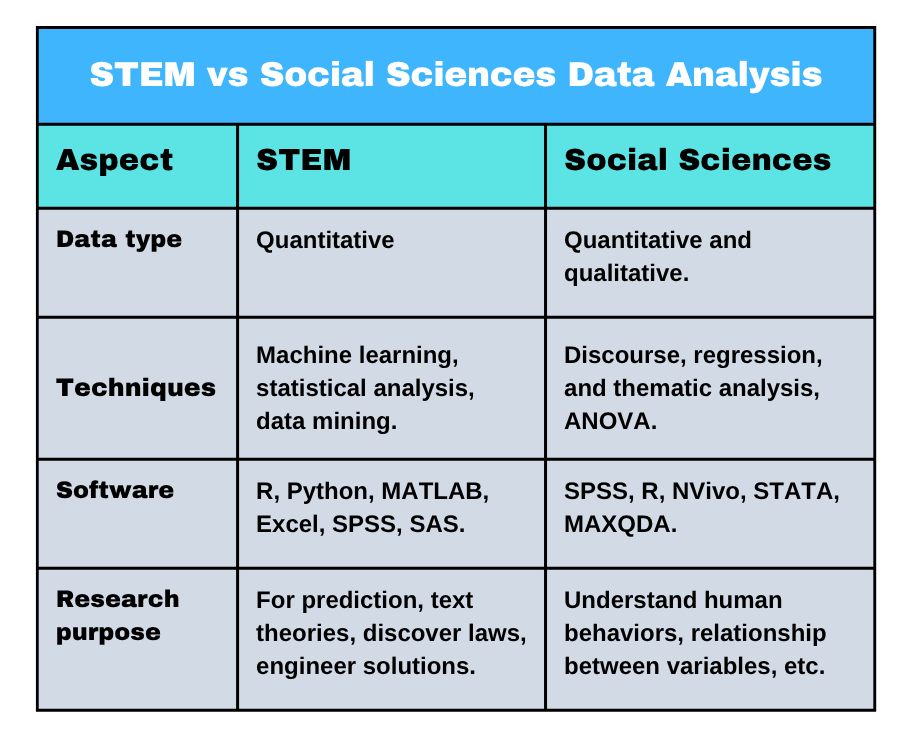
Data analysis approaches in STEM and the social sciences differ mainly in the methodology employed. STEM fields rely on mathematical and statistical techniques to analyze data and draw meaningful conclusions, while the social sciences combine both quantitative and qualitative analysis methods and tools to understand individual experiences. Are you looking to hire a data analysis consultant for help with data analysis in any STEM field or social science discipline? Look no further because our professionals are readily available to help. Contact us today or join our live chat to talk to our sociable customer support agents for inquiries on mixed methods data analysis.