

How to Handle Missing Data in Your Dissertation Research
Missing data in dissertation research reduces the statistical power of a study, increases the likelihood of Type II errors, and decreases the sample size, thereby affecting the validity and reliability of the results. By effectively handling missing data, PhD students can ensure the integrity of a dataset, avoid selection and measurement bias, and maintain the statistical power of their models, thereby conducting an analysis that produces credible findings. Are you seeking professional help to handle missing data in a dissertation? At data-analysisservices.com, we offer specialized assistance with handling missing data in dissertations, ensuring the completeness of data and thereby the representativeness of the sample and reliability of the results. In this article, we have discussed missing data in dissertation research, illustrating the techniques and software tools our professionals apply when handling missing data.
What is Missing Data in Dissertation Research?
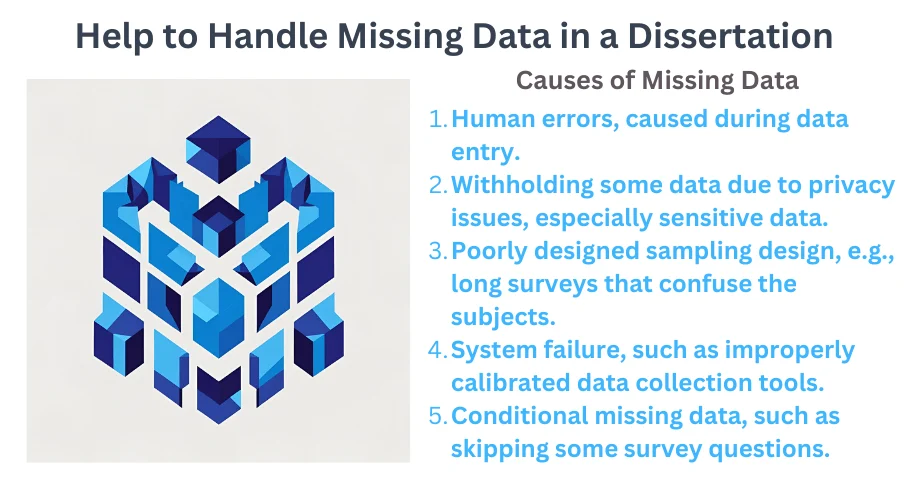
Missing data in dissertation research is the absence of values for the variables of interest in a dataset. In dissertations, missing data can be attributed to the respondent’s refusal to provide information, technical malfunctions such as equipment breakdown, human errors, or failure to follow up on the results, among others. Missing data in a dissertation can be classified into three categories, which are (i) missing completely at random (MCAR), (ii) missing at random (MAR), and (iii) not missing at random (NMAR).
Techniques Used to Handle Missing Data in a Dissertation
1. Listwise Deletion
Listwise deletion is a technique that involves eliminating all observations with missing digits on any variable and only including observations with all the values in the analysis. The listwise deletion method is suitable for dissertations with missing values that are completely at random, as the missingness is unsystematic. The values that will be deleted are randomly distributed throughout the dataset, thereby correcting standard errors. The listwise deletion technique can be applied to any statistical analysis in a dissertation, and no advanced computer methods are required.
2. Pairwise Deletion
Pairwise deletion is a technique that involves eliminating information only when a specific data point required to conduct a statistical test is missing. Pairwise deletion involves maximizing the use of the available data to conduct the analysis. A pairwise deletion is more appropriate for dissertation studies with Missing Completely at Random or Missing at Random data. The pairwise deletion technique is more suitable for dissertations because it preserves more information, thereby resulting in more accurate statistical findings.
3. Single Imputation
Single imputation involves developing and replacing missing data with reasonable estimated values based on similar observed variables. The main techniques applied in the singular imputation of missing values in dissertation data include mean or median, and regression imputation. The mean or median imputation techniques are suitable when the dissertation data have both continuous and discrete variables. The mean or median imputation method encompasses replacing missing values with the average value of the observed data. When the dissertation data is normally distributed, the mean imputation is applied; however, if the data has skewness, the median imputation is used. Another single imputation technique applied when handling dissertation data is regression imputation, which involves estimating the missing values using a regression model applied to other variables in the dataset.
4. Multiple Imputation
Multiple imputation involves filling in missing values by developing plausible values based on the distributions and relationships among variables in the dataset. To conduct multiple imputation, the PhD student should generate replacement values using software tools such as the Multiple Imputation tool in SPSS and repeat this procedure multiple times to obtain multiple datasets with replaced information. The doctoral candidate then analyzes the multiple imputed data sets and combines the findings to get accurate estimates of the dissertation data and the uncertainty caused by the missing values. Some of the techniques applied in multiple imputation include multiple imputation with chained equations and random forest imputation strategies. By conducting a multiple imputation analysis, doctoral students analyze complete datasets while considering the uncertainty of the imputed values, thereby ensuring the accuracy and reliability of the results.
Other techniques applied by our professionals in handling missing data in a dissertation include, but are not limited to, Naïve Bayes, hot-deck, average, common-point, and maximum likelihood imputation. In case you need specialized help to handle missing data in a dissertation, contact our professional consultants to find out how we can help.
Software Tools Used to Handle Missing Data in Dissertation Research
1. How to Handle Missing Data in SPSS
SPSS is a statistical software package that contains various tools and functionalities that are used to explore, identify, and handle missing values before conducting data analysis in a dissertation. To discover how many missing values a variable has in dissertation data, in SPSS, click on Analyze> Descriptive Statistics>Frequencies. Enter the variables in the variables list, then click OK, and the output will display the number of missing digits. Features in SPSS that make it suitable for handling missing data in a dissertation include:
(i) The Missing Value Analysis procedure that describes the pattern of the missing data, displays the descriptive statistics for missing values, and fills in the missing digits with estimated values using regression or expectation-maximization.
(ii) The Multiple Imputation function that generates possible digits for the missing values, therefore developing complete data sets for the dissertation analysis.
2. How to Handle Missing Data in R
In the R programming language, missing values in a dataset are represented by the words NA or NaN. To determine the number of missing values in the dissertation data in R, utilize is.na() alongside the sum() functions. Compute the number of missing values in each column of the dataset using the colSums() function and is.na() to identify the columns with missing data and the total values missing from each. In R, PhD scholars can handle missing data for their dissertations by either deleting rows with missing values or imputing values. To eliminate rows with NA or NaN values in R, utilize the na.omit() function.
3. How to Handle Missing Data in Python
In Python, PhD students can utilize Pandas’ functions to identify missing values in the dissertation data. Some of the functionalities in the Panda library used to detect missing data in Python include: a). isnull (), b). .notnull(), c). .isna(), and d). .info(). To handle missing data in dissertation analysis in Python, use the drop () function to eliminate observations with missing values from the dataset. Alternatively, the doctoral student can use Panda’s function fillna() to perform simple imputation techniques such as mean, median, or mode imputation. For expert help in handling missing data in a dissertation, contact our professional consultants today for assistance with selecting the best techniques and ensuring the reliability of results.


Why Get Help to Handle Missing Data in a Dissertation from Our Experts?
We have the best subject matter experts with postgraduate degrees in fields such as Statistics, Computer Science, and Data Science. We apply our knowledge and expertise to utilize the best techniques and tools to handle missing data in our clients’ dissertations effectively.
Professionals from our company have over 10 years of experience in assisting PhD students with various phases of their dissertation research, including handling missing data. We apply simple and complex missing data handling techniques to help our clients draw meaningful conclusions.
Our services are not limited to handling missing data; we provide expert assistance with analyzing, interpreting, visualizing, and composing detailed reports that highlight how we effectively addressed the missing data.
When offering help to handle missing data in a dissertation, we provide customized services tailored to the client’s specific research questions and data. Whether they need assistance with handling missing data in Excel, SPSS, STATA, or SAS, we have data analysts with expert-level proficiency in missing data management.
Summary
Missing data in a dissertation refers to missing values of the variables of interest that should be present but are not. By decreasing the statistical power of a study and increasing the likelihood of type II errors, missing data can compromise the validity and reliability of dissertation results. Looking for help to handle missing data in a dissertation? Contact our expert team today for personalized assistance with handling missing data for your dissertation.