

Mistakes to Avoid in Dissertation Data Analysis
After investing their time in collecting data, most Ph.D. researchers are eager to reach the data analysis stage. Nevertheless, pitfalls also exist that make researchers fail to develop a successful dissertation, especially the inconsistencies in the data analysis. Errors in data analysis of the dissertation may lead to invalid results and arguments, causing the dissertation to be rejected by the reviewing committees. You may be wondering, Where can I hire an expert to correct data analysis errors? Our company has qualified and experienced experts who offer personalized dissertation data analysis services tailored to each client’s specific requirements. This article contains some of the frequent errors scholars make when analyzing data and how to prevent them.
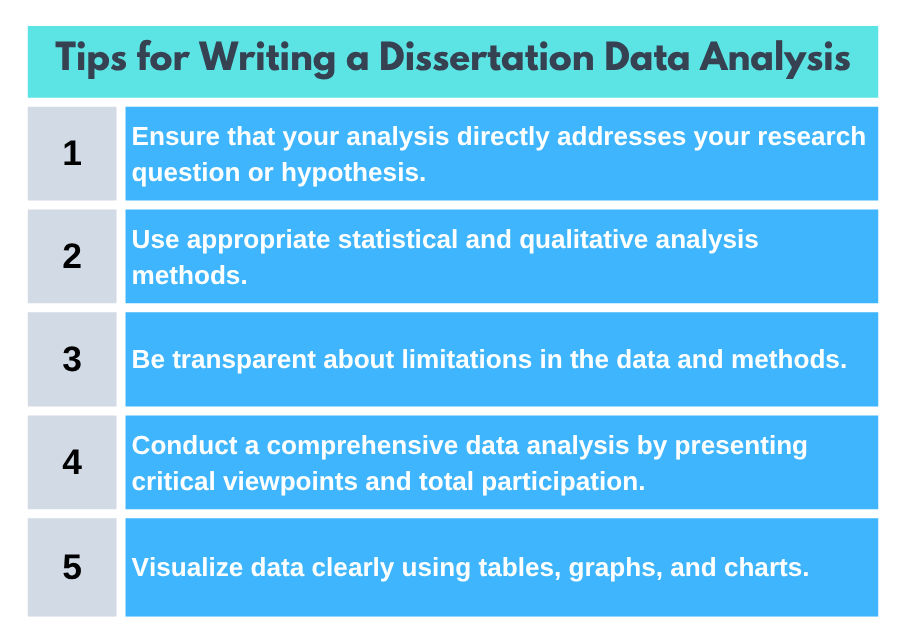
Avoid These Dissertation Data Analysis Mistakes by Hiring Experts to Correct Data Analysis Errors
1. Choosing the Wrong Statistical Test
Failure to understand the type of data or research question leads to the inappropriate use of statistical tests. For example, a researcher may apply an independent samples t-test, where a one-way ANOVA or a linear regression with a categorical dependent variant would be more appropriate. To prevent the use of inappropriate statistical tests, one should begin by understanding the research question and determining the measurement level for each variable, represented in ratio, nominal, ordinal, or interval terms. Researchers should match the tests to their study designs and data types. Also, the normal distribution of data should be checked to decide on parametric or non-parametric tests. If you are unsure about the type of test to apply, consider reaching out to us for professional assistance to eliminate data analysis mistakes and refine the analysis process.
2. Ignoring the Assumptions of Statistical Tests
Scholars should verify the assumptions accompanying statistical tests, including independence, normality, and homogeneity of variance. The findings may become invalid when one ignores such assumptions. For example, failing to check the variances in the t-test may result in inconclusive outcomes. Researchers should avoid the mistake of ignoring the assumptions of statistical tests by performing proper tests, such as scatterplots to evaluate linearity, the Shapiro-Wilk test for normality, and Levene’s test for homogeneity. When test assumptions are violated, the scholar should either change the data or use non-parametric statistical tests, such as the Mann-Whitney U test. Our statisticians help with checking these assumptions, propose valid options, and assist with documenting the process appropriately in the methodology section.
3. Inadequate Data Cleaning and Preparation
Rushing to analysis may lead to the replication of entries, missing numbers, inappropriate labeling of variables, or extreme outliers, which distort the study results. Duplicate table entries or outliers can be easily biased to skew regression coefficients and produce false trends. In order to prevent this, one can conduct exploratory data analysis (EDA) based on descriptive statistics, boxplots, and histograms to clean data. Researchers should ensure that variables are coded accurately and have proper labels. A professional analyst helps researchers clean their dataset and ensures they have perfected their data structure for meaningful and accurate analysis.
4. Poor Handling of Missing Data
Listwise deletion automatically removes the rows containing missing values and can bias the study results and decrease the sample size. Researchers ought to identify whether their missing data is either missing completely at random (MCAR), missing at random (MAR) or missing not at random (MNAR). Depending on the circumstances, scholars are supposed to apply appropriate methods such as expectation maximization, multiple imputation, or pairwise deletion.
To prevent the poor handling of missing data, researchers should design tools to reduce missing responses, monitor data collection in real-time to detect patterns of missing data and create a comprehensive plan for managing missing data in the research. Appropriate management of missing data requires technical skills. Our specialists have the required technical skills to help customers achieve model validity, synthesize findings, and reduce model bias to meet the highest standards of academic rigor.
5. Confidence Intervals and p-Values Misinterpretation
The main misunderstanding regarding the analysis of dissertations is that a p-value below 0.05 supports the hypothesis or that a confidence level is infallible. The p-value is the likelihood of the data occurrence under the conditions when the null hypothesis is accurate. In contrast, a confidence interval provides a range of possible values, not a certainty. Statistical significance does not necessarily imply practical or clinical significance. Our professional statisticians help the scholars interpret the data collected with the help of SPSS, R, STATA, or SAS software, transfer the statistical analysis results into the academic language, and prevent exaggerations undermining the study’s validity. Our experts are highly experienced and have excellent analytical skills, which enable them to help our clients analyze data, regardless of the methodological techniques.
6. Underfitting or Overfitting the Model
The other mistake researchers make is overfitting or underfitting the model by either using too few variables in the model or too many. Overfitting leads to a model that performs well on the data but badly on new data. Underfitting is too simplistic and causes one to miss important predictors. An example is the inclusion of all the demographic variables as predictors without testing their relevance, resulting in a crowded model with minimal explanatory power. In fine-tuning the model, researchers are advised to employ methods such as cross-validation, adjusted R2 2 and AIC/BIC to prevent underfitting or overfitting. It requires statistical knowledge to determine whether the model is underfitting or overfitting. Thus, involving a data expert enables the researchers to balance the model’s simplicity with accuracy.
7. Making Causal Claims from Correlational Data
Implying causation from observational or correlational studies is another common mistake in writing a dissertation. For instance, saying X causes Y based on a cross-sectional study raises red flags for dissertation committee members and reviewers. In a non-experimental study or in research where random assignment is not used, the scholars ought to be careful with language and use words such as correlates with, is associated with, or predicts. Scholars can hire our statistical analysts to help them interpret their dissertation results and ensure the language used is within the accepted standards of academic writing.


Why Hire an Expert to Correct Data Analysis Errors?
We have qualified and experienced experts who ensure clients’ data satisfies the key assumptions, such as independence, normality, linearity, and homoscedasticity. Detecting and correcting the violations of the statistical assumptions increases the reliability and integrity of the statistical results.
Our team ensures that the statistical method used by the clients is appropriate to their research questions, hypotheses, and the nature of the data. Research design and methodology misalignment can result in committee rejection or concerns. Our validation process reinforces the client’s dissertation foundation by ensuring each analytical step aligns with the academic expectations.
Our statisticians assist clients in selecting tests that are statistically feasible and align with the research design and measurement scale. Accurate selection of statistical tests leads to the validity of the results and the academic justification of the findings.
Reviewers and committees often reject dissertations because of unclear or vague data analysis. Our professional input enhances the justification, clarity, and accuracy of clients’ statistical work, reducing revision cycles and speeding up dissertation approval by the review committee. We have statisticians who have experience in conducting data analysis for different clients in diverse disciplines. We are also open around the clock to cover different time zones, handle last-minute revisions, and even help clients who have to meet short deadlines. Reach out to us today for the best experts in correcting data analysis errors.
Summary
Scholars spend months, even years, gathering, formulating, and analyzing their dissertation data. Due to the dedication and hard work required, scholars ought to take some corrective actions to prevent mistakes that can be avoided to cause delays in completing their dissertations in time. Avoiding dissertation data analysis mistakes significantly enhances dissertation results and minimizes researchers’ stress, whether revising after feedback or in the early analysis stages. One can hire an expert to correct data analysis errors and assist in completing their data analysis. Contact us now or speak with our knowledgeable customer service agents via our live chat for customized dissertation analysis services tailored to your specific needs.