

Get Help to Conduct Survey Data Analysis
Survey data analysis is used to analyze and interpret collected responses through statistical and analytical techniques. The goals of analyzing survey data are to transform raw data into meaningful conclusions that can inform decision-making, identify trends and patterns, and measure the impact of specific initiatives. For those in need of survey data analysis help, at data-analysisservces.com, we provide specialized support in conducting survey data analysis to gain a deeper understanding of respondents’ opinions.
This article provides a comprehensive overview of survey data analysis, encompassing its definition, a step-by-step process, and the software tools used in academic and research settings. We have also included the quantitative techniques employed by our experts when providing help with survey data analysis, such as descriptive and inferential methods, among others.
What is Survey Data Analysis?
Survey data analysis is the process of utilizing mathematical and analytical techniques to analyze survey data and make meaningful conclusions about the population. Survey data analysis helps transform raw data into useful insights by categorizing similar responses to identify recurring patterns and themes and computing descriptive measures to determine participant satisfaction levels. By conducting survey data analysis, researchers gain insight into the opinions and thoughts of participants, thereby enabling them to understand individual needs, make informed decisions, address issues, and evaluate the effectiveness of interventions.
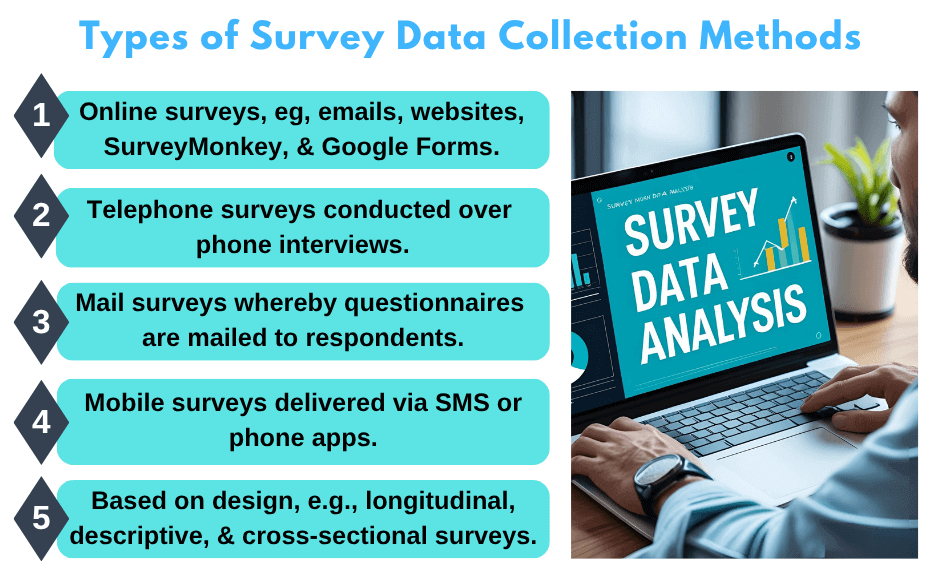
What are the Statistical Methods of Survey Data Analysis?
1. Descriptive Analysis of Survey Data
Descriptive analysis is the first step in survey data analysis, which involves organizing and summarizing the major characteristics of the survey scores. Examples of descriptive statistics methods utilized in survey data analysis include the measures of central tendency, position, and variation. Measures of central tendency include the mean, mode, and median, which describe survey data by identifying the average in the data set. The measures of position are used to determine the position of individual values in relation to other values in the survey dataset. In descriptive analysis of survey data, the measures of variability illustrate how far the data points are from the center of the distribution.
2. Inferential Analysis of Survey Data
Inferential analysis of survey data involves applying various hypothesis testing and estimation techniques to analyze the data and generalize the findings to the entire population beyond the sample that took the survey. Common inferential analysis methods applied in survey analysis include regression, correlation, confidence intervals, t-tests, chi-square tests, and ANOVA, among others. By conducting inferential analysis on survey data, analysts can evaluate the validate hypotheses, determine the statistical significance of relationships, make predictions, and estimate population parameters.
What are the Steps followed in the Statistical Analysis of Survey Data?
To conduct an effective statistical analysis of survey data that leads to accurate and reliable results, researchers require skills and extensive knowledge of mathematical techniques and tools, which is why hiring an expert is essential. When providing survey data analysis help, our professionals follow seven main steps. In step 1, prepare the data for analysis by organizing and cleaning. Organizing involves arranging the survey responses in a structured format, with a row representing a participant and a column representing a variable. Cleaning survey data involves checking for errors, such as outliers and missing values, to remove them and ensure uniformity.
Step 2 involves conducting an exploratory data analysis by computing the measures of descriptive statistics and visualizing the distribution of responses in the survey data. In step 3, the researcher conducts data transformation by recoding variables to simplify or modify existing data to conduct survey data analysis. Step 4 involves conducting a statistical analysis based on the research questions and objectives. In step 5, we develop graphical representations of the data to illustrate the analysis findings. Step 6 involves interpreting the results of the statistical analysis, determining their significance in the context of the research questions, and then drawing conclusions based on these findings.
Software Tools Utilized in Statistical Analysis of Survey Data
1. Survey Data Analysis in SPSS
SPSS is a software package utilized for statistical analysis of survey data, widely used due to its easy-to-follow command language and wide array of statistical techniques. With SPSS, data analysts can prepare survey data for analysis, apply various statistical analysis techniques, interpret the results, and report the findings. The step-by-step procedure of conducting a survey data analysis in SPSS involves:
Step 1: Data preparation, which involves entering, cleaning, and defining variables.
Step 2: Exploring data using descriptive statistics and visualization to identify patterns, detect errors, and identify the most suitable statistical analysis technique to apply.
Step 3: Conducting statistical analysis based on the type of variables in the survey data and the research questions.
Step 4: Interpretation and reporting. Interpreting survey data analysis results in SPSS involves identifying patterns and trends and explaining the findings in relation to the research question. The statistician evaluates important values such as the descriptive statistics measures, p-values, and confidence intervals. When reporting the findings, the analyst should customize the survey analysis reports according to the type of document, such as a dissertation, thesis, research paper, or business report. If you require professional assistance with conducting survey data analysis in SPSS for your research or scholarly document, our certified statisticians are available to help. We provide professional SPSS survey data analysis help, from data preparation to composing data analysis reports.
2. Survey Data Analysis in Excel
Microsoft Excel is a spreadsheet program used for survey data analysis due to its statistical analysis functionalities and the availability of features such as pivot tables, which allow for the description and visualization of responses using summary tables. Additionally, Excel has a comprehensive list of calculations, known as functions, that can perform simple arithmetic operations, such as counting survey responses (COUNTIF), adding (SUM), or computing the average response in the survey (AVERAGE). Excel also contains a variety of chart types that statisticians can utilize to visualize survey data, such as pie, area, column, line, combo, and pivot charts, among others.
The procedure of conducting a survey data analysis in Excel involves:
Step 1: Arrange survey data using a Likert scale.
Step 2: Install a data visualization tool known as ChartExpo.
Step 3: Open Excel and click on Insert.
Step 4: Select ChartExpo and click on Insert.
Step 5: Select the Likert Scale chart.
Step 6: Develop a chart for the survey data.
Step 7: Interpret survey data analysis results.
3. Survey Data Analysis in Python
Python is a widely used programming language, mainly due to its easily understandable syntax and a vast collection of libraries, which are valuable for conducting survey data analysis. One of the key features in Python that makes it suitable for conducting survey analysis is the ability to develop and manage data structures. Survey data, particularly with text responses, is usually unstructured, so statisticians can apply the Pandas library to develop data frames that allow them to sort, filter, and analyze survey data. To conduct a survey data analysis in Python, follow this step-by-step procedure:
Step 1: Import libraries to be used for survey data analysis, such as Pandas, NumPy, SciPy, Statsmodels, Matplotlib, Seaborn, and Plotly.
Step 2: Enter survey responses into Python.
Step 3: Clean data by handling missing data and eliminating irrelevant survey responses.
Step 4: Conduct feature engineering using encoding and cross-tabulation.
Step 5: Conduct exploratory data analysis by developing graphics and applying cross-analysis to observe patterns and trends.
Step 6: Make conclusions.
Step 6: Develop a chart for the survey data.
Step 7: Interpret survey data analysis results.


Why Get Survey Data Analysis Help From Our Experts?
Our platform features an expert team of statisticians and data analysts with extensive background experience in conducting survey data analysis for clients across multiple areas of research.
Professionals from our company provide customized survey research services. Whether clients need help with analysis, interpretation, or visualization, we provide exceptional assistance with every step of the survey research process.
Our professional data analysis consultants are available around the clock to ensure prompt responses to any client inquiries, enabling us to provide assistance to both local and international clients in need of survey data analysis help.
Our highly skilled data analysts offer professional assistance with operating qualitative and statistical software tools. For statistical analysis of survey data, we utilize software such as R, STATA, SAS, Tableau, and Minitab, among others.
After analysis, we compose detailed survey analysis reports to help our clients understand the results and conclusions made from the analysis. The survey data analysis report typically consists of an executive summary that outlines the survey’s aim, research objectives, findings, and recommendations. It also includes a methodology section that outlines the data collection and analysis procedures, as well as the methods used to ensure validity and reliability. The report also includes a results section that presents the findings of the analysis, along with a visual representation of the data for easy understanding.
Summary
Survey data analysis involves the application of statistical methods and qualitative analysis procedures to gain information from survey data. Conducting an effective survey data analysis that yields accurate results requires skills and knowledge of analytical tools and techniques. If you are looking for specialists to conduct your survey data analysis, our experts are readily available to provide survey data analysis help. Reach out to us via our live chat to speak with one of our friendly customer support agents or contact us with any inquiries; you will receive a prompt response to your questions.