

Expert Help with Qualitative Market Research
Market research is the practice of collecting, analyzing, and interpreting information about consumers, competitors, and market trends to help business owners understand the market and make evidence-based decisions. In market research, researchers employ qualitative or quantitative approaches to collect and analyze data, gaining useful information that enables them to understand their customers, determine the feasibility of their products or services, and develop competitive strategies. Are you searching for reliable qualitative market research experts? Our skilled market researchers provide outstanding services for start-ups and existing businesses to help them maximize the potential of their organizational activities and create an effective roadmap that leads to future growth. This article provides a comprehensive overview of qualitative market research, highlighting the methods employed, the advantages of utilizing a qualitative market research approach, and an example.
What is Qualitative Market Research?
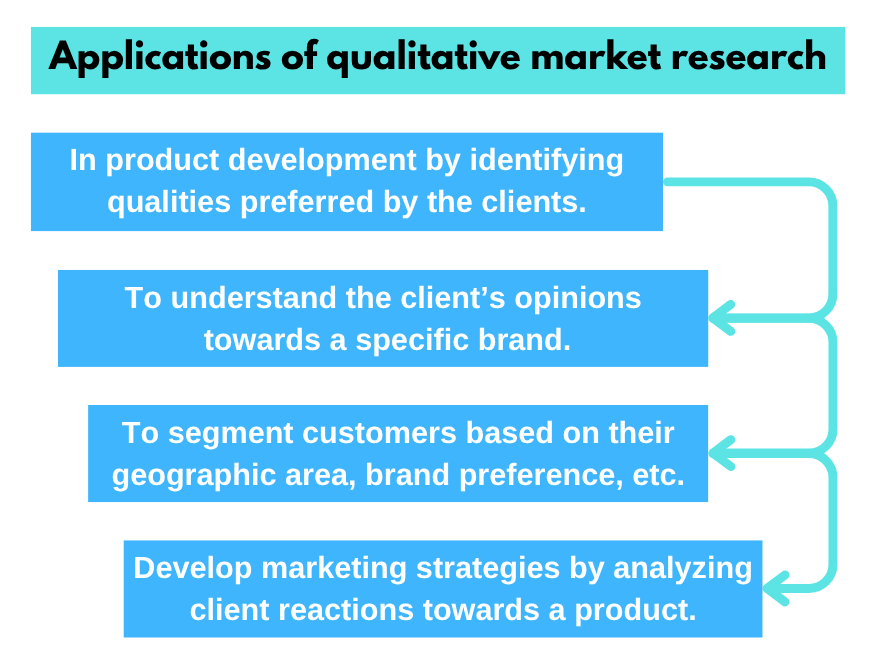
Qualitative market research is an exploratory procedure that involves collecting and analyzing non-numerical data to understand consumers’ behaviors, opinions, experiences, and expectations. By applying qualitative data collection and analysis techniques, market researchers aim to understand and interpret phenomena through customer’s personal views and experiences. With qualitative market research, business owners get an in-depth understanding of the current market situation, predict future trends, and plan strategically to enable business growth.
Methods Used in Qualitative Market Research
1. Observation
Observation is a qualitative method that involves the researcher observing the respondents, either by observing them alone or by participating in their daily activities. Market researchers take note of everything they see. Through the investigator’s field notes, the researcher obtains an accurate representation of the phenomenon under study and firsthand, unbiased information, thereby obtaining accurate results. It is most suitable for low-budget market research where the respondents are in a closed setting.
2. In-depth interviews
In-depth interviews are a qualitative research technique used to gather data and understand the subjective opinions and perspectives of consumers regarding specific goods or services. In-depth interviewing techniques should be applied in market research when information about the consumer’s attitudes, beliefs, and behavior is crucial to answering the research question, particularly when exploring a new product in the market or when the customer’s narratives can provide additional insights beyond other methodologies. The significance of in-depth interviews in market research is that business owners and stakeholders gain firsthand, detailed feedback from respondents, thereby understanding their preferences and making informed decisions.
3. Focus groups
Focus groups are a qualitative research method that involves a structured discussion with a group of people controlled by a moderator to generate data through a collection of open-ended questions. In qualitative market research, focus groups are used to gather information on the attitudes and perspectives of consumers to understand why they would buy a certain product or service and their desired outcomes after purchasing it. The focus group sessions should have an open format to allow for more open discussions. The focus group participants involved should also be homogenous so that the individuals feel more at ease sharing their thoughts and experiences about the phenomenon under study.
Process of Conducting Qualitative Market Research
When conducting qualitative market research, market researchers follow this step-by-step procedure:
Step 1: Define the Research Problem
Defining the research problem involves specifying what the study aims to discover and the information the market researcher is interested in. The research problem is usually formulated based on the business’s unresolved questions, practical concerns, or emerging issues. A poorly defined research problem can result in the application of the wrong research methods, thereby collecting irrelevant data and failing to resolve the business’s market research issue. The research problem should be feasible, clearly articulated, and specific in scope.
Step 2: Planning the Qualitative Market Research
When conducting qualitative market research, the investigator identifies the participants, techniques, and tools to be used to conduct the research. The researcher defines the number of respondents and the selection criteria for choosing participants, identifies the moderator for the qualitative study, and selects the location where the qualitative market research will take place. An excellent qualitative market research plan is significant because it ensures that the study is well-organized and achieves the intended goals and objectives.
Step 3: Data Collection
Data collection in qualitative market research enables investigators to gather valuable information about respondents’ attitudes and perspectives on specific products and services. The data collection technique employed depends on the study’s objectives, scope, volume of data required, time available for conducting qualitative market research, and the desired sample size. Common qualitative market research methods include interviews, focus groups, document analysis, open-ended questionnaires, and observation.
Step 4: Data Analysis and Interpretation of Results
Qualitative data analysis involves utilizing analytical techniques and software tools to analyze data and understand the meaning behind the actions and behaviors of consumers. The qualitative data analysis process typically involves preparing the data, familiarizing oneself with it, coding, categorizing, and memoing, and developing themes and patterns that explain the complex phenomena. Common qualitative data analysis methods applied in market research include thematic, content, narrative, discourse analysis, and grounded theory. Interpretation of results in qualitative market research involves constant revisiting and refining as new patterns and themes emerge, providing a rich description of the information under study.
Step 5: Reporting
Composing the report involves documenting the findings of the qualitative market research process to understand the business landscape, learn about the attitudes and preferences of present and target consumers, and make informed decisions. A market research report begins with an executive summary, followed by an introduction, a description of the participants, the methodology used, results, discussion, conclusions, and recommendations. By demonstrating findings such as customer intent and client feedback, the report connects the research aims to effective recommendations, ensuring that the results lead to growth and innovation.
Advantages of Qualitative Market Research
Conducting qualitative market research enables business owners and stakeholders to keep up with the evolving market trends. By monitoring social media data, online discussions, and competitor activities, stakeholders gain useful insights into shifting consumer preferences, therefore understanding market demands over time.
With qualitative market research, business owners can understand consumer preferences, behaviors, and experiences, thereby tailoring their strategies to ensure customer satisfaction. Qualitative market researchers are able to understand the “why” behind consumer attitudes and behaviors, thereby enabling business owners to understand their target audience and customize their products and services to meet their preferences.
By gathering valuable insights from conducting qualitative market research, businesses can effectively reduce customer churn rates. By understanding the needs and preferences of consumers and making informed decisions based on the acquired information, stakeholders can increase customer loyalty and decrease churn rates.
Conducting qualitative market research enables stakeholders to adopt effective marketing strategies that drive organizational growth.
Example of Qualitative Market Research
A fashion company aims to assess and understand the evolving perceptions of individuals regarding sustainable fashion. The shareholders decided to conduct qualitative market research to develop a comprehensive understanding of the participants’ preferences. They hired qualitative market researchers who employed focus groups and in-depth interviews as methods to collect data. The researchers selected respondents from diverse backgrounds and with different fashion tastes from various locations to acquire a wide range of perspectives. They also asked open-ended questions about what sustainability means to them and how it influences their fashion choices. The experts then conducted a thematic analysis to identify common themes and patterns in the interview transcripts and made valid conclusions related to consumer preferences and the importance of sustainable fashion. Based on the findings, the company adjusted its product development to avail more clothes and shoes that are ethically made and environmentally friendly.


Why Get Qualitative Market Research Services from Our Experts?
Our team comprises skilled moderators and qualitative market researchers with over 10 years of experience in conducting qualitative market research for clients across various fields. We offer exceptional assistance in analyzing qualitative data, helping clients understand consumer behavior and enabling them to plan strategically and make informed decisions.
Professionals from our company offer customized qualitative market research services based on our clients’ needs. Whether clients need help with phenomenological, ethnographic, or grounded theory studies, our professionals tailor our solutions to deliver accurate and reliable results.
We apply the best qualitative market research practices and conduct extensive and in-depth qualitative research to identify recurrent patterns and themes in our clients’ qualitative data.
Our qualitative market research service providers offer a fast turnaround time without compromising on the quality of findings.
Our professional consultants provide comprehensive customer support, from initial inquiry to final results delivery, to ensure that the qualitative market research achieves its intended research objectives.
Summary
Qualitative market research is a significant process because the researcher gets detailed information on how to improve the business directly from customers. Getting professional market research services can significantly contribute to a business’s success. Contribute to your business growth today by hiring our qualitative market research experts! Contact us today to get started. Our team of experts is available 24/7 to respond to your inquiries and work on your requests promptly. Additionally, we keep our clients informed about the progress of their work, allowing them to review and make adjustments as needed. Click our order process to learn how to place an order now.